Guides · Reading guide
Learn Spanish by reading.
How easy is easy enough, what to read at each level, how to use a translation without leaning on it, and how much to read.
October 20, 2026
In 2000, Marcella Hu and Paul Nation gave 66 students in New Zealand a 633-word story in English with some of its words swapped for nonsense. When one word in five was nonsense, not one reader understood the story well enough to pass their test. At one in ten, a few did. They worked out that most readers need to know about 98 percent of the words, one unknown word in fifty, before a story makes sense on its own.
That number explains nearly everything about learning Spanish by reading: why it works so well for some people, and why most people who try it with a real novel give up by chapter two.
The short answer
You can learn a great deal of Spanish by reading, if what you read is easy enough. Pick stories written for learners at your level, where you already know almost every word. Read the Spanish first and look at a translation only for the sentence that won’t come clear. Look up words that keep coming back, not every word you don’t know.
Then read a lot. Volume, not difficulty, is what teaches you.
Facing Pages · bilingual stories
Read Spanish with English on the facing page
228 original stories in Spanish, French and English, with your own language on the facing page, matched sentence by sentence. The first episode of every series is free.


How easy is easy enough
Ninety-eight percent sounds abstract until you put it on a page. The beginner stories in our Spanish library all come in under 300 words. At 98 percent, a 250-word story has five words you don’t know. Five is enough to learn something and few enough to keep the plot.
So here is the test we’d use before committing to anything in Spanish, a book, a story, an article: read the first page and count the words you’d have to guess.
- Five or fewer: read it. This is where reading teaches you.
- Six to ten: fine for slow study with a pencil, too hard to read for pleasure.
- More than ten: put it back. Come to it in six months.
The figure deserves a caveat. Hu and Nation never tested 98 percent directly. They tested 80, 90, 95 and 100 percent and estimated the rest, and later studies have found the line between too hard and fine is blurrier than a single number suggests. As a rule of thumb it still holds, for a reason that has nothing to do with statistics: easy reading is the reading you finish, and finished stories are what build a vocabulary.
Our stance is blunt: ten easy stories beat one hard one.
What to read at each level
The levels below are the Common European Framework’s (CEFR), the scale behind the official DELE exams and many Spanish courses, from A1 for a first-term beginner to C1 for someone who reads the news without effort. The grammar column is what the stories in Facing Pages use at each level, so you know what you’ll meet.
| Level | What to read | Grammar you’ll meet |
|---|---|---|
| A1 | Stories of up to 300 words written for learners, built on about the 1,000 most common words | The present tense, ir a + infinitive for the future, gustar |
| A2 | The same length, with more happening | Adds the preterite (fue, tuvo, hizo) for finished events |
| B1 | Stories of 400 to 700 words with natural dialogue; graded readers | Preterite and imperfect side by side, the future, the conditional, the first subjunctives after quiero que and ojalá |
| B2 | Longer stories, novels for teenagers, a translated novel you already know | The full subjunctive, including the imperfect subjunctive and si clauses |
| C1 | Novels and journalism written for native speakers | Everything, plus idiom and regional Spanish |
Two books get recommended to beginners constantly, and neither belongs in the first year. Don Quijote is the first: Cervantes published it in 1605 and 1615, and its Spanish is four centuries old; plenty of native speakers find it heavy going. Picture books for toddlers are the second, and they’re hard in a sneakier way. Their grammar is simple, but their words are chosen for small children, rhymes and farm animals, and the pictures carry half the story. Stories written for adult learners control vocabulary on purpose and are about things an adult would actually read about.
A translated novel you know well in English is a good first “real” book once you reach B2. You already know what happens, so every sentence you can’t parse is a puzzle with the answer in your head.
Using the English without leaning on it
A translation beside the Spanish, called parallel text, is the fastest way through a story at the edge of your level. It’s also the easiest way to read a story in English while believing you read it in Spanish. Your eyes drift to the familiar side, the plot arrives through English, and the Spanish becomes decoration.
The fix is an order, kept strictly. Read the whole Spanish sentence first. If it came clear, keep going. If it didn’t, read it once more, and only then look across. After the English, go back and read the Spanish a final time, now that you know what it says, because that last pass is where the grammar sinks in.
The translation has to be matched sentence by sentence for this to work. A translation of the whole chapter at the back of the book, or on the next page, makes you hunt for the line you need, and hunting breaks the reading. In Facing Pages each Spanish sentence is paired with its English: tap one and its partner lights up on the facing page.
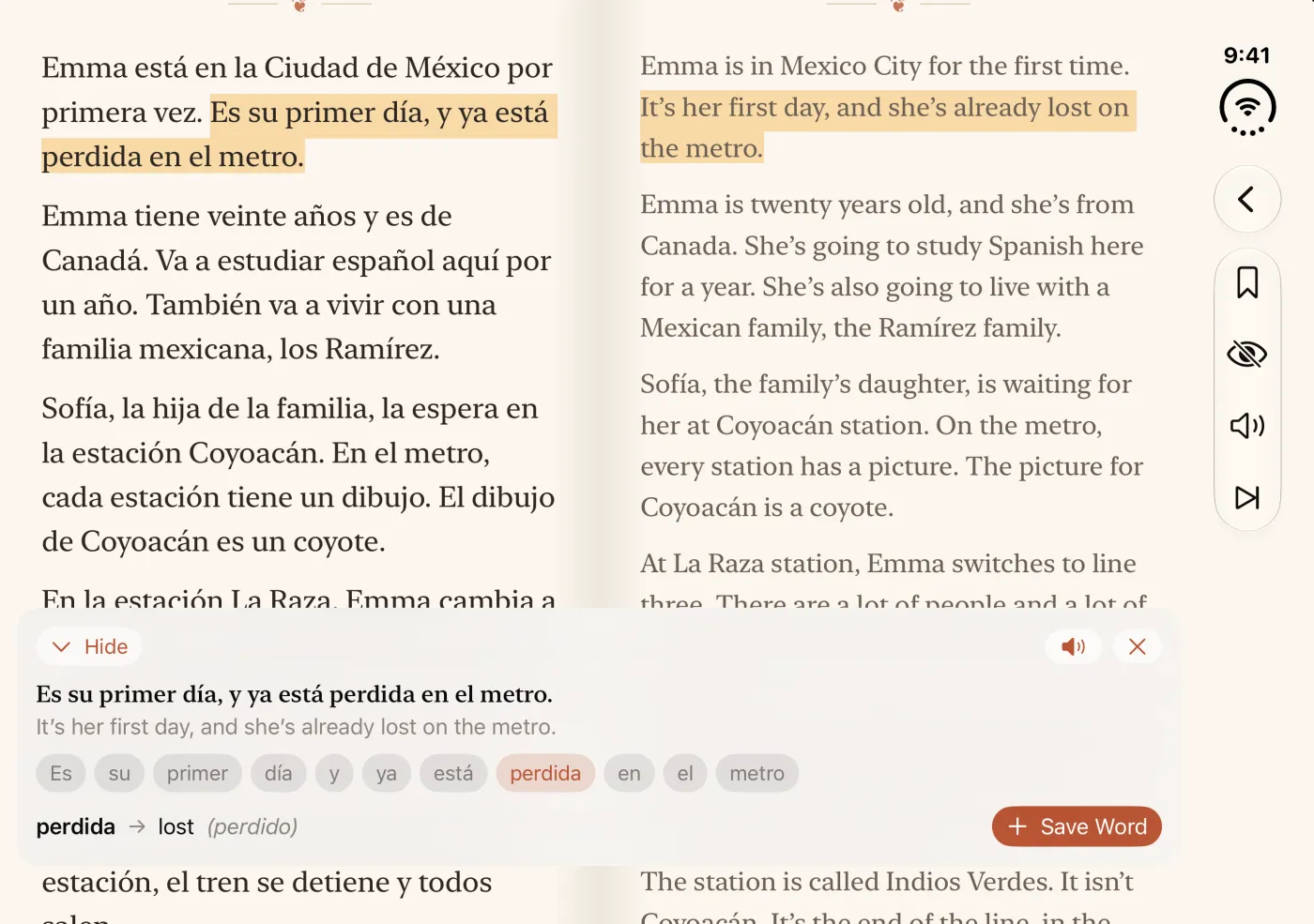
Once a story reads easily with the English beside it, take the English away. On an iPhone, or with an iPhone Duo folded shut, Facing Pages shows one page in Spanish and slides up the translation only for the sentence you tap.
Which words to look up
Looking up every unknown word feels diligent. It quietly wrecks the reading. Each lookup lifts you out of the story, and a paper dictionary hands you a column of meanings when you need the one that fits this sentence.
Look a word up when it blocks the meaning of the sentence, or when you see it for the third time. Let the rest go. A word that matters will come back, and when it does, the second sentence often explains the first.
Words you do save should keep their sentence. On its own, perdida is a flashcard. In Es su primer día, y ya está perdida en el metro, it is a person, a place and a feeling, and you also see that it ends in -a because Emma is a woman; a lost man is perdido. Facing Pages saves each word with the sentence you found it in, for exactly that reason.
Listen while you read
Spanish spelling is close to phonetic, so reading teaches you more about pronunciation than reading English ever could. It can’t teach you speed, stress or the way words run together in speech. For that, listen to the same text you’re reading.
A good routine for a story you like: read it silently for the plot; listen to it while you follow the words; then read it aloud yourself, a sentence at a time. In Facing Pages every sentence can be read aloud by your phone’s own voices, with the sentence highlighted as it’s spoken. It sounds slow. It’s the quickest way we know to make one story’s Spanish your own.
Facing Pages · bilingual stories
Read Spanish with English on the facing page
228 original stories in Spanish, French and English, with your own language on the facing page, matched sentence by sentence. The first episode of every series is free.
One page, read properly
Here is the opening of El perro perdido, an A1 story set in Seville, with our English beside each paragraph. Try the order: Spanish first, then the English only if you need it.
Un sábado, Curro encuentra un perro perdido en un parque de Sevilla. Es pequeño, marrón y tiene las orejas enormes.
One Saturday, Curro finds a lost dog in a park in Seville. He’s small and brown, and he has huge ears.
Curro tiene nueve años. Está en el parque con su hermana mayor, Rocío, de dieciséis años.
Curro is nine years old. He’s at the park with his big sister, Rocío, who is sixteen.
El perro tiene un collar rojo con una chapa. En la chapa dice «Canelo», pero no hay número de teléfono.
The dog has a red collar with a name tag. The tag says “Canelo,” but there’s no phone number.
«¿Dónde vive Canelo?», pregunta Curro.
“Where does Canelo live?” Curro asks.
«No sé, pero hay que buscar a su dueño», dice Rocío.
“I don’t know, but we have to look for his owner,” Rocío says.
Most beginners will stop at three words. Chapa is the tag on a dog’s collar, a word used in Spain. Dueño means owner. Hay que buscar is the interesting one: hay que plus an infinitive means “one has to” or “we have to”, and you’ll see it constantly once you’ve noticed it.
Look at buscar a su dueño, too. The a doesn’t mean “to”. Spanish puts a small a in front of a person who receives the action, the so-called personal a, and leaves it out for things: busco a mi hermana, I’m looking for my sister, but busco las llaves, I’m looking for the keys. Three words, one grammar point, and you haven’t opened a textbook. The whole story, and two more, are in our Spanish short stories for beginners.
How much, and how often
Twenty minutes every day will take you further than two hours every Sunday. Reading builds vocabulary by repetition, and words fade between meetings, so frequency matters more than stamina.
Series help more than people expect. Read six episodes about the same family in the same city and the same few hundred words keep returning in new sentences, which is how a word moves from recognized to known. It’s the reason we write so much of our library as series told in episodes.
Reread, too. The second time through a story you liked, you’re not decoding any more. You’re reading Spanish, at something close to a native reader’s pace, and that feeling is worth chasing. Pick something easy for tonight, easier than feels useful, and see how far you get before you want to stop.
Questions
Can you learn Spanish just by reading?
You can build a large vocabulary, a feel for the grammar and real reading fluency mostly through reading. Speaking and understanding fast speech need practice of their own, so pair reading with listening, ideally to the same texts.
How many words do you need to know to read in Spanish?
For stories written for learners, far fewer than you think: beginner stories stay within about the 1,000 most common words. For novels written for native speakers, the best-known estimate, made for English by Paul Nation in 2006, is 8,000 to 9,000 word families to know 98 percent of the words.
Is it good to read children’s books to learn Spanish?
Not at first. Picture books have simple grammar but use vocabulary chosen for small children and rely on the pictures to tell the story. Stories written for adult learners are easier to follow and teach the words adults use. Novels for teenagers work well at B2.
Should I translate every word when reading in Spanish?
No. Look up a word when it stops you understanding the sentence or when you meet it for the third time. Guess the rest from the story and keep reading.
What should a beginner read first in Spanish?
Short stories written for learners at A1, around 150 to 300 words, in the present tense, with a translation matched sentence by sentence so you can check a line without losing your place.
Is reading or listening better for learning Spanish?
They teach different things. Reading gives you time to notice grammar and spelling and to pick up vocabulary; listening trains your ear for speed and pronunciation. Listening to a text while you read it gets you both.
What is the best app to learn Spanish by reading?
We make Facing Pages, so weigh our answer accordingly. Whatever you choose, look for stories written at your level, a translation matched sentence by sentence, word lookups that give the meaning in that sentence, and audio of the same text.
Facing Pages · bilingual stories
Read Spanish with English on the facing page
228 original stories in Spanish, French and English, with your own language on the facing page, matched sentence by sentence. The first episode of every series is free.