Guides · Stories
Spanish short stories for beginners.
Three complete A1 stories, from Seville, Bogotá and Mexico City, with our English beside every paragraph and the words and grammar each one teaches.
October 20, 2026
Nearly every story you’ve read in English is told in the past tense: she walked, he said. Telling a story that way in Spanish takes two past tenses at once, the preterite and the imperfect, and choosing between them is a B1 skill. So the three stories below do something most novelists don’t. They’re told almost entirely in the present tense, and that single choice is what lets a beginner read them from the first line to the last.
Each one is complete and under 300 words, and each comes from a different corner of the Spanish-speaking world: Seville, Bogotá and Mexico City. Our English sits beside every paragraph. Use it as a net, not a ladder.
The short answer
Three complete A1 Spanish short stories with English translation are on this page: El perro perdido (Seville), El café de la esquina (Bogotá) and Emma en México (Mexico City). Read the Spanish first, look across at the English only for a sentence you can’t work out, then read the Spanish once more.
A good beginner story is short, mostly in the present tense, and built from the thousand or so most common words, plus a handful of new ones the story itself teaches you.

Facing Pages · bilingual stories
More Spanish stories, from your first week to advanced
228 original stories in Spanish, French and English, with your own language on the facing page, matched sentence by sentence. The first episode of every series is free.


El perro perdido · Seville, Spain
A boy, his big sister and a dog with a name tag but no phone number. The whole story is a walk around one Seville neighborhood, and the same few places come round twice: the newsstand, the fruit shop, the pharmacy. For a beginner, that kind of repetition is a gift.
Un sábado, Curro encuentra un perro perdido en un parque de Sevilla. Es pequeño, marrón y tiene las orejas enormes.
One Saturday, Curro finds a lost dog in a park in Seville. He’s small and brown, and he has huge ears.
Curro tiene nueve años. Está en el parque con su hermana mayor, Rocío, de dieciséis años.
Curro is nine years old. He’s at the park with his big sister, Rocío, who is sixteen.
El perro tiene un collar rojo con una chapa. En la chapa dice «Canelo», pero no hay número de teléfono.
The dog has a red collar with a name tag. The tag says “Canelo,” but there’s no phone number.
«¿Dónde vive Canelo?», pregunta Curro.
“Where does Canelo live?” Curro asks.
«No sé, pero hay que buscar a su dueño», dice Rocío.
“I don’t know, but we have to look for his owner,” Rocío says.
Primero, van al quiosco de la esquina. El señor del quiosco mira al perro y se ríe.
First, they go to the newsstand on the corner. The man at the newsstand looks at the dog and laughs.
«¡Es Canelo! Viene aquí todos los días, pero no sé dónde vive», dice el señor.
“It’s Canelo! He comes here every day, but I don’t know where he lives,” the man says.
Después, van a la frutería. La frutera también conoce a Canelo. Cada mañana, el perro come una zanahoria en su tienda.
Next, they go to the fruit shop. The fruit seller knows Canelo too. Every morning, the dog eats a carrot in her shop.
En la farmacia pasa lo mismo. Canelo duerme la siesta todas las tardes en la puerta, al sol.
At the pharmacy, the same thing happens. Canelo takes a nap by the door every afternoon, in the sun.
«Todo el barrio conoce a este perro. Pero nadie sabe dónde vive», dice Curro.
“The whole neighborhood knows this dog. But nobody knows where he lives,” Curro says.
Cansados, los hermanos se sientan en una plaza llena de naranjos. De repente, Canelo corre hacia una calle pequeña. Curro y Rocío corren detrás.
Tired, the brother and sister sit down in a square full of orange trees. Suddenly, Canelo runs toward a little street. Curro and Rocío run after him.
Canelo entra en una barbería muy antigua. Dentro, un señor mayor le corta el pelo a un cliente.
Canelo goes into a very old barbershop. Inside, an older man is cutting a customer’s hair.
«¡Por fin estás aquí, Canelo!», dice el barbero.
“You’re finally here, Canelo!” the barber says.
El barbero se llama don Rafael, y Canelo es su perro. Todos los días, Canelo sale a visitar a sus amigos del barrio.
The barber’s name is don Rafael, and Canelo is his dog. Every day, Canelo goes out to visit his friends in the neighborhood.
«Gracias por cuidar a Canelo. ¿Quieres pasearlo los sábados, con tu hermana?», pregunta don Rafael.
“Thank you for taking care of Canelo. Would you like to walk him on Saturdays, with your sister?” don Rafael asks.
«¡Me encanta la idea!», dice Curro.
“I love that idea!” Curro says.
Ahora, todos los sábados, Curro y Rocío pasean a Canelo. Primero van al quiosco, después a la frutería y después a la farmacia. Canelo conoce el camino, y Curro tiene amigos nuevos en todo el barrio.
Now, every Saturday, Curro and Rocío walk Canelo. First they go to the newsstand, then to the fruit shop and then to the pharmacy. Canelo knows the way, and Curro has new friends all over the neighborhood.
Three small things carry most of the grammar. Curro tiene nueve años: in Spanish you have your years rather than being them. Hay que buscar a su dueño uses hay que plus an infinitive for “we have to”, and the a before su dueño is the personal a that Spanish puts in front of a person, or a much-loved dog, on the receiving end of a verb: conoce a Canelo.
The third is easy to miss. Tiene las orejas enormes says “he has the ears huge”. Spanish uses “the” for body parts where English says “his”, because whose ears they are is already obvious.
| Spanish | Meaning |
|---|---|
| perdido | lost (adjective) |
| dueño | owner (noun) |
| collar | collar (for a dog) (noun) |
| chapa | name tag on a dog's collar (Spain) (noun) |
| quiosco | kiosk, newsstand (noun) |
| frutería | fruit shop (noun) |
| barbería | barbershop (noun) |
| naranjo | orange tree (Seville's streets are full of them) (noun) |
| pasear | to walk (a dog), to go for a walk (verb) |
El café de la esquina · Bogotá, Colombia
A waiter who never writes anything down, and a customer he has never seen asking for “the usual”. It’s a tiny detective story. The clue is in the fourth paragraph.
Julián es mesero, y tiene una memoria increíble. Nunca escribe nada, y nunca olvida un pedido.
Julián is a waiter, and he has an incredible memory. He never writes anything down, and he never forgets an order.
Trabaja en un café pequeño de La Candelaria, en Bogotá. Todos lo llaman «el café de la esquina».
He works in a small café in La Candelaria, in Bogotá. Everyone calls it “the corner café.”
Julián conoce a todos sus clientes. Don Álvaro siempre pide un café con leche y pan. La señora Gloria pide chocolate con queso. Pone el queso dentro del chocolate, como muchos bogotanos.
Julián knows all his customers. Don Álvaro always orders a café con leche and bread. Señora Gloria orders chocolate con queso. She puts the cheese inside the chocolate, like many people in Bogotá.
Don Fabio siempre pide un café negro y dos almojábanas. Se sienta en la mesa de la ventana y hace el crucigrama del periódico. Siempre tiene un lápiz detrás de la oreja.
Don Fabio always orders a black coffee and two almojábanas. He sits at the table by the window and does the crossword in the newspaper. He always has a pencil behind his ear.
Pero ahora don Fabio vive en Cali, con su hijo. Julián lo extraña un poco.
But now don Fabio lives in Cali, with his son. Julián misses him a little.
Un martes de lluvia, entra una clienta nueva. Es una mujer joven, y se sienta en la mesa de la ventana.
One rainy Tuesday, a new customer comes in. She’s a young woman, and she sits at the table by the window.
«Lo de siempre, por favor», dice la mujer.
“The usual, please,” the woman says.
Julián no sabe qué hacer. Es la primera vez que ve a esta mujer. ¿Cómo va a saber qué es «lo de siempre»?
Julián doesn’t know what to do. It’s the first time he has seen this woman. How is he supposed to know what “the usual” is?
Entonces, Julián la mira con atención. La mujer abre un periódico y busca el crucigrama. Después, saca un lápiz de detrás de la oreja.
Then Julián looks at her carefully. The woman opens a newspaper and looks for the crossword. Then she takes a pencil from behind her ear.
Julián sonríe. Va a la cocina y vuelve con un café negro y dos almojábanas.
Julián smiles. He goes to the kitchen and comes back with a black coffee and two almojábanas.
«¿Cómo lo sabe?», pregunta la mujer.
“How do you know?” the woman asks.
«Usted hace el crucigrama igual que don Fabio», dice Julián.
“You do the crossword just like don Fabio,” Julián says.
«¡Don Fabio es mi abuelo! Él dice que este es el mejor café de la ciudad», explica ella.
“Don Fabio is my grandfather! He says this is the best café in the city,” she explains.
Desde ese día, ella viene todos los martes. Y siempre pide lo de siempre.
From that day on, she comes every Tuesday. And she always orders the usual.
Un día, la mujer entra con un señor mayor. Tiene el pelo blanco y un lápiz detrás de la oreja.
One day, the woman comes in with an older man. He has white hair and a pencil behind his ear.
«Lo de siempre, para dos», dice don Fabio.
“The usual, for two,” don Fabio says.
Esta vez, Julián no necesita pensar. Ya tiene los dos cafés en la mano.
This time, Julián doesn’t need to think. He already has the two coffees in his hands.
This one is full of Bogotá. A waiter is a mesero here, as in Mexico; in Spain he’d be a camarero. Chocolate con queso is exactly what it sounds like, hot chocolate with a piece of cheese dropped in to soften, and almojábanas are small cheese breads. Extrañar, to miss someone, is the Latin American verb; in Spain you’ll more often hear echar de menos.
Listen to how people speak to each other, too. Julián calls the young woman usted, and she answers ¿Cómo lo sabe?, not ¿Cómo lo sabes? Bogotanos use usted far more than most Spanish speakers, sometimes even with friends and family, so here it sounds warm rather than stiff. A textbook that teaches usted only as the polite form for strangers will leave you puzzled in Bogotá.
And lo de siempre, word for word “the thing of always”, is how you order your usual almost anywhere Spanish is spoken. It’s worth learning as one chunk.
Emma en México: El primer día · Mexico City
The first of five episodes about Emma, a 20-year-old Canadian student, on her first day in Mexico City. She takes the metro to meet her host sister and ends up at the wrong end of the line.
Emma está en la Ciudad de México por primera vez. Es su primer día, y ya está perdida en el metro.
Emma is in Mexico City for the first time. It’s her first day, and she’s already lost on the metro.
Emma tiene veinte años y es de Canadá. Va a estudiar español aquí por un año. También va a vivir con una familia mexicana, los Ramírez.
Emma is twenty years old, and she’s from Canada. She’s going to study Spanish here for a year. She’s also going to live with a Mexican family, the Ramírez family.
Sofía, la hija de la familia, la espera en la estación Coyoacán. En el metro, cada estación tiene un dibujo. El dibujo de Coyoacán es un coyote.
Sofía, the family’s daughter, is waiting for her at Coyoacán station. On the metro, every station has a picture. The picture for Coyoacán is a coyote.
En la estación La Raza, Emma cambia a la línea tres. Hay mucha gente y mucho ruido. Sin pensar, Emma se sube al primer tren.
At La Raza station, Emma switches to line three. There are a lot of people and a lot of noise. Without thinking, Emma gets on the first train.
Pasan una, dos, tres estaciones, pero no hay ningún coyote. En la tercera estación, el tren se detiene y todos salen.
One, two, three stations go by, but there’s no coyote. At the third station, the train stops and everyone gets off.
La estación se llama Indios Verdes. No es Coyoacán. Es el final de la línea, en el norte de la ciudad. Y Coyoacán está en el sur.
The station is called Indios Verdes. It isn’t Coyoacán. It’s the end of the line, in the north of the city. And Coyoacán is in the south.
Cerca de la salida hay una señora con uniforme del metro. Un poco nerviosa, Emma va hacia ella.
Near the exit, there’s a woman in a metro uniform. A little nervous, Emma walks over to her.
«Perdón, señora, ¿dónde está el coyote?», pregunta Emma.
“Excuse me, ma’am, where is the coyote?” Emma asks.
A la señora le da risa. «¿Vas a Coyoacán, mija?», pregunta.
This makes the woman laugh. “Are you going to Coyoacán, sweetie?” she asks.
«Sí», dice Emma.
“Yes,” Emma says.
«Vas en la dirección contraria», dice la señora. «Necesitas el tren a Universidad».
“You’re going in the opposite direction,” the woman says. “You need the train to Universidad.”
La señora lleva a Emma hasta el otro andén. Ahora Emma va en el tren correcto. Esta vez, mira cada dibujo con mucho cuidado.
The woman takes Emma to the other platform. Now Emma is on the right train. This time, she looks at every picture very carefully.
Por fin, Emma ve el coyote en la pared. En el andén, una chica tiene un letrero enorme con su nombre.
At last, Emma sees the coyote on the wall. On the platform, a girl is holding a huge sign with her name on it.
«¡Bienvenida a México, Emma!», dice Sofía, y le da un abrazo.
“Welcome to Mexico, Emma!” Sofía says, and she gives her a hug.
«Ya conozco toda la línea tres», dice Emma con una sonrisa.
“I already know all of line three,” Emma says with a smile.
Camino a casa, Emma saca un cuaderno pequeño. Es para sus palabras nuevas en español. Escribe la primera: «perdida». Después escribe la segunda: «coyote».
On the way home, Emma takes out a small notebook. It’s for her new Spanish words. She writes the first one: “perdida.” Then she writes the second one: “coyote.”
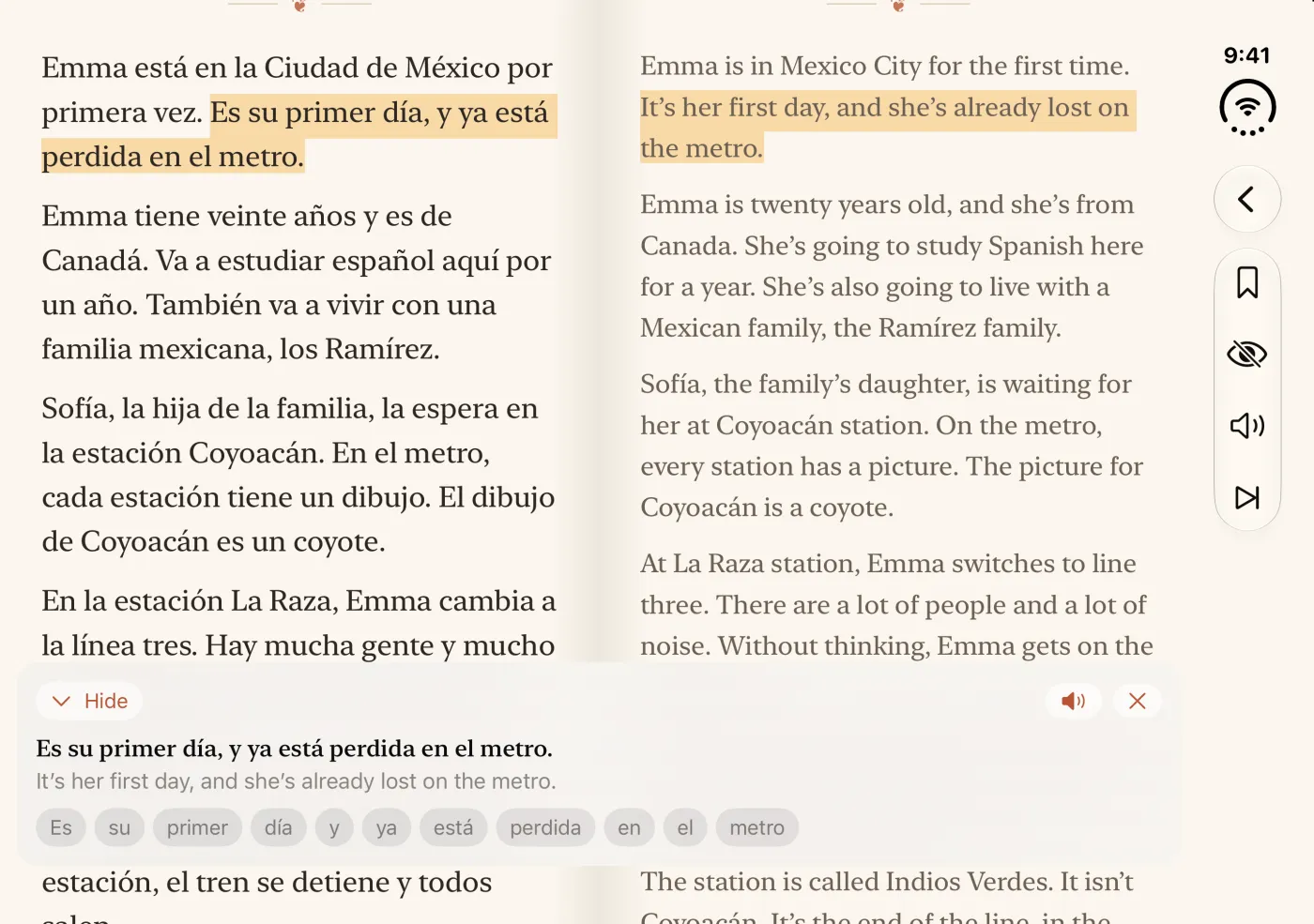
Every detail of Emma’s route is real. Line 3 runs north to south between Indios Verdes and Universidad, and Coyoacán is on it, toward the southern end, so a train heading north really does take her away from Sofía. Since the first line opened in 1969, each station has had its own picture, from a system designed by a team led by Lance Wyman so that travelers could find their way without reading the signs. Coyoacán’s is a coyote: the name comes from Nahuatl and is usually translated as “place of coyotes”.
The grammar is the core of A1:
- Estar for where and how Emma is (está en la Ciudad de México, está perdida), ser for where she’s from (es de Canadá).
- Va a estudiar, va a vivir: ir a plus an infinitive, the future tense you can use from your first week.
- Mija, short for mi hija, “my daughter”, is how a Mexican woman might kindly address a girl or a young woman she doesn’t know. The English “sweetie” is close.
Notice what Emma does at the end, too. Her first two words in her notebook are perdida and coyote, the two words the day taught her. That’s how vocabulary sticks: attached to a moment, not a list.
Facing Pages · bilingual stories
More Spanish stories, from your first week to advanced
228 original stories in Spanish, French and English, with your own language on the facing page, matched sentence by sentence. The first episode of every series is free.
What to read after these
When all three read easily, and they will sooner than you expect, move up to A2. The stories stay short, but finished events start to appear in the preterite: fue, tuvo, hizo. La paella de la abuela, set in Valencia, is a good first A2 story and is free in Facing Pages. After that come intermediate stories of 400 to 700 words, where the preterite and the imperfect finally meet.
If you’re not sure a story is at your level, count the words you’d have to guess on the first page. Five or fewer in 250 words and you’re in the right place; we explain why in how to learn Spanish by reading.
Then come back to these three in a week. If Canelo’s walk through Seville feels like a street you’ve been down before, you’re ready for the past tense.
Questions
Where can I read Spanish short stories for beginners for free?
Three complete ones are on this page, with English beside every paragraph. In the Facing Pages app, the first episode of every series and a selection of stories at every level are free to read.
What level are these Spanish stories?
All three are A1, the first level of the Common European Framework of Reference: present tense, short sentences and everyday words, with a few topic words explained in each story.
Should beginners read Spanish stories with an English translation?
Yes, if the translation is matched paragraph by paragraph or sentence by sentence and you read the Spanish first. Use the English to rescue a sentence you can’t work out, then read the Spanish again.
Are these stories in Spain Spanish or Latin American Spanish?
Both. Each story uses the Spanish of its setting: chapa for a dog’s name tag in Seville, mesero and usted in Bogotá, mija in Mexico City. The grammar is the same everywhere at this level.
How long should a Spanish short story for beginners be?
Under about 300 words. That’s long enough for a real plot with a twist and short enough to read two or three times in one sitting, which is where most of the learning happens.
Can I listen to these stories in Spanish?
In the Facing Pages app, every sentence can be read aloud by your phone’s own voices and is highlighted as it’s read, so you can follow the Spanish while you listen.
Facing Pages · bilingual stories
More Spanish stories, from your first week to advanced
228 original stories in Spanish, French and English, with your own language on the facing page, matched sentence by sentence. The first episode of every series is free.