Guides · Reading guide
Parallel text, sentence by sentence.
Where facing-page translation came from, why a translation matched sentence by sentence beats one matched by the page, and how to read it without slipping into the English.
October 22, 2026
Open any volume of the Loeb Classical Library and the whole idea is there on the spread: Greek or Latin on the left-hand page, English on the right. The banker and philanthropist James Loeb founded the series in 1911, the first volumes came out in 1912, and the layout has never changed, down to the green covers for Greek and the red for Latin. Reviewing it in the Times Literary Supplement in 1917, Virginia Woolf wrote that it “came as a gift of freedom,” and conceded that “we shall never be independent of our Loeb.”
For a reader of Greek, that was the bargain, and a fair one. The same layout is now sold to people learning Spanish and French, as parallel text, dual-language books or bilingual books for adults, and for them the bargain has to run the other way. A learner’s parallel text should be one you need a little less every week. That changes what a good one looks like, and how you read it.
The short answer
A parallel text sets a book in two languages side by side: the original on one page, a translation facing it. Dual-language books and bilingual books for adults are the same thing under other names. Three things decide whether one will teach you: how closely the two sides are matched (sentence by sentence beats page by page), whether the translation is faithful (it keeps each sentence and its order without going word for word), and how you use it.
Read the language you’re learning and treat the English as an answer key you check, not a second book you read. Most of what it can teach you is in the places where the two sides don’t match.

Facing Pages · bilingual stories
Spanish and French stories with English matched sentence by sentence
228 original stories in Spanish, French and English, with your own language on the facing page, matched sentence by sentence. The first episode of every series is free.


Word, page, sentence
Broadly, there are three ways to line two languages up, and each has had its turn.
The oldest is word by word. In 1693, in Some Thoughts Concerning Education, John Locke told parents to teach a child Latin with an easy book such as Aesop’s fables: the English translation, “made as literal as it can be,” written on one line, and above each English word the Latin word that answers it. Interlinear translation shows you exactly which word means what. The price is English that isn’t quite English, and a reader who learns words without ever seeing how the other language builds a sentence.
The Loeb moved the unit up to the page, and so did most of the bilingual books sold to learners today as parallel texts or dual-language editions: the original on one page, a translation on the other, matched spread by spread. Short stories, poems, classic tales; the layout barely changes from one shelf to the next.
A page suits a scholar, or anyone who simply wants the poem and its meaning in view at once. For a learner a page is too big, just as a word is too small. The sentence is the right size.
Why the sentence wins
On a printed spread, checking one sentence means finding it first. Your eye crosses the fold, lands a line or two off and reads on to get its bearings, and by the time it has, you’ve taken in three sentences of English you didn’t need. The story has started arriving in English. Nor is the translator trying to help you find your place. Good literary translators split, merge and reorder sentences whenever English asks for it, which is their job, so the line you want may sit two sentences below its partner.
A sentence is the smallest piece a translator can keep faithful while still writing real English. That is the rule for the English beside our Spanish and French stories: one English sentence for each original sentence, in the same order, faithful first and natural second. Across the 21 free Spanish stories in our library, it comes to 1,189 Spanish sentences, each with exactly one English partner.
In Facing Pages you tap a sentence and only its partner lights up across the fold. You see the English you asked for, and nothing past it.
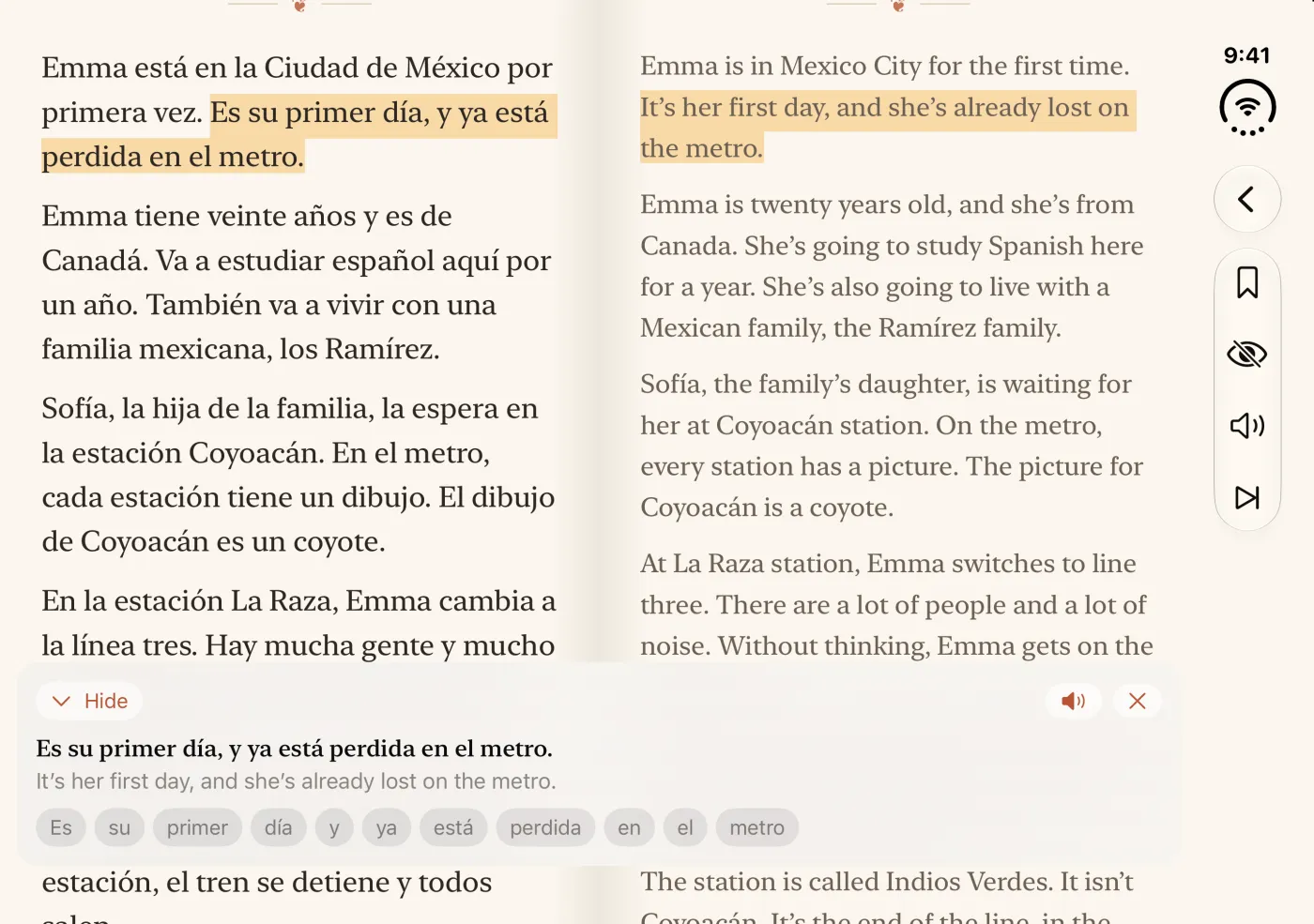
The order we’d read in, Spanish first and the English only to rescue a sentence that won’t come clear, is set out in how to learn Spanish by reading. What that guide leaves out is what to do with the English once you’ve looked. That’s where a parallel text earns its keep.
Read the gaps
A faithful translation keeps the meaning, not the words, so the two sides disagree all the time in small ways. Every disagreement marks a place where Spanish does something English can’t. Those places are the most valuable thing in any parallel text, and a page-matched book buries them.
Here are three paragraphs from La carta, a C1 story set on Salamanca’s calle Libreros. A book restorer has just been handed a letter addressed to her grandmother, thirty years after it was posted. These paragraphs tell us who the grandmother was.
La abuela Matilde había fallecido hacía quince años, y en la familia todavía se hablaba de ella con una sonrisa. Durante cuatro décadas había llevado una pensión para estudiantes en el primer piso de aquel mismo edificio de piedra dorada. Ahora, en la planta baja, Elena restauraba libros antiguos para la universidad y para algún coleccionista despistado.
Grandma Matilde had passed away fifteen years earlier, and the family still spoke of her with a smile. For four decades she had run a boarding house for students one floor up, in that very same building of golden stone. Now, on the ground floor, Elena restored antique books for the university and for the occasional absent-minded collector.
Sobre la abuela, todos contaban la misma historia. Decían que tenía un corazón enorme y una cabeza desastrosa para los números. Cobraba poco, hacía la vista gorda cuando algún estudiante se retrasaba con el pago y, a final de mes, nunca le cuadraban las cuentas.
When it came to Grandma, everyone told the same story. They said she had an enormous heart and a hopeless head for numbers. She charged too little, turned a blind eye whenever a student fell behind with the rent, and at the end of the month her accounts never balanced.
«La pensión sobrevivió de milagro», solía decir el padre de Elena, entre resignado y orgulloso.
“It’s a miracle that boarding house survived,” Elena’s father used to say, half resigned and half proud.
Read the Spanish, then line the two sides up and look for the places where they part company. Here are six.
| The Spanish | Our English | What the gap teaches |
|---|---|---|
| una pensión para estudiantes | a boarding house for students | A false friend. Pensión can mean a pension, but the Real Academia’s dictionary also defines it as a house that takes in guests for an agreed price. |
| en el primer piso | one floor up | In Spain the street level is the planta baja, so the primer piso is what an American calls the second floor. A literal “first floor” would put Matilde’s boarders in Elena’s workshop. |
| Cobraba poco | She charged too little | Bare poco leans toward “not enough,” like English “little”; un poco would have been “a bit.” |
| hacía la vista gorda | turned a blind eye | An idiom, word for word “made the fat sight.” The Real Academia defines it as pretending, discreetly, not to have seen something. |
| nunca le cuadraban las cuentas | her accounts never balanced | In Spanish the accounts are the subject: cuadrar is what a column of figures does when its totals agree, and le says whose problem it was. |
| La pensión sobrevivió de milagro | It’s a miracle that boarding house survived | De milagro, “by a miracle,” also means “only just.” English had no tidy place for the phrase, so the sentence was rebuilt around it. |
None of those is a mistake. A word-for-word version (“made the fat sight,” “a disastrous head for numbers,” “on the first floor”) would be worse English and a worse teacher, because it would hide exactly what the Spanish was doing. The habit to build is small: when the English surprises you, stop and work out what the Spanish did that English couldn’t.
Keeping your eyes on the Spanish
Everyone who reads parallel text knows the drift. A hard sentence, a glance across, another, and three paragraphs later you’re reading the English and nodding at the Spanish as it goes by. Willpower doesn’t fix that. Friction does.
- Cover the English. With a paper book, lay a postcard over the facing page and slide it down only when you mean to. In Facing Pages, read on one page: on an iPhone, or an iPhone Duo folded shut, the Spanish fills the screen and the English for a sentence appears only when you tap it.
- Ration your looks. Decide before each page how many you’ll allow, three, say, and spend them on the sentences the plot hangs on. A budget turns every glance into a choice.
- Read backwards. When you finish a page, cross the fold the other way. Pick an English phrase you like and hunt for its Spanish twin: “turned a blind eye” sends you looking for hacía la vista gorda, and a phrase you hunted for stays with you longer than one you were handed. No other kind of book lets you do this.
- Read it twice, the second time alone. The first pass, with the English, is for the story. The second, a day later with the English covered, tells you which sentences you understood and which you only borrowed.
One more rule, about level. Save parallel text for stories a step above what you could read on your own, where the English rescues you a few times a page. At your own level, it’s only a temptation.
Facing Pages · bilingual stories
Spanish and French stories with English matched sentence by sentence
228 original stories in Spanish, French and English, with your own language on the facing page, matched sentence by sentence. The first episode of every series is free.
Choosing a dual-language book
A lot of what’s sold as bilingual books is for small children. The shelf for adults is shorter, and much of it was made with other readers in mind: students of literature, lovers of poetry, people who want the classics without the struggle. Before you buy one to learn from, open it in the middle.
First, pick a sentence near the bottom of the left-hand page and time how long it takes to find its English. Two seconds is fine. Much longer than that and you’ll either stop checking or start reading the English instead; a book matched paragraph by paragraph is a fair compromise, and one that sets whole chapters against each other is hard work.
Then look at the age of the language. Some collections open with tales written centuries ago, and Spanish has moved on since. Lovely later; hard going now.
Check whether the text is the author’s or an adaptation. Some readers retell classic stories in simplified Spanish. That makes them easier, and it also means the sentences aren’t the authors’ own. Neither choice is wrong, as long as you know which one you’ve made.
And be wary of poetry. Facing-page editions of poems are often the most beautiful books on the shelf and the hardest to learn from, because a poem’s translator has to change more than anyone else, so the two sides seldom line up for long.
Short stories in modern prose are the easiest place to start, in Spanish or French; our Spanish short stories for beginners and French short stories for beginners are free ones to practice on.
Woolf expected to lean on her Loeb for life, and for a reader of Greek that was a reasonable deal. Expect the opposite of yours. The surest sign a parallel text is working is the evening you reach the end of a chapter and realize you never once looked across.
Questions
What is a parallel text?
A book or story printed in two languages side by side, usually the original on one page and a translation on the facing page, so a reader can compare them line by line. Learners use it to read stories a little beyond their level without stopping for a dictionary.
Is parallel reading good for learning a language?
Yes, with two conditions. The translation has to be matched closely, ideally sentence by sentence, so checking one line doesn’t mean reading ten; and you have to read the language you’re learning, using the English to check sentences rather than reading it as the story. Without the second, you end up reading a book in English.
What are dual-language books?
The same thing as parallel texts: a book with the original and a translation facing each other. Many books sold as bilingual are for young children, so check the age group before you buy one to learn from.
Are there dual-language novels for adults?
Some, but the best-known series for adults lean toward short stories, poetry and classic plays. For a first parallel text, short stories are the better choice anyway: you finish one in a sitting, and each story is a fresh start.
What does parallel reading mean?
Reading a text side by side with its translation, checking one against the other as you go. It works best when the two are matched sentence by sentence and you read the language you’re learning first, looking across only for the sentence you can’t work out.
Where can I read parallel text in Spanish and English for free?
On this site: the excerpt above, and our Spanish short stories for beginners, three complete stories with our English beside every paragraph. In the Facing Pages app, the first episode of every series and a selection of stories at every level are free, each matched sentence by sentence.
Facing Pages · bilingual stories
Spanish and French stories with English matched sentence by sentence
228 original stories in Spanish, French and English, with your own language on the facing page, matched sentence by sentence. The first episode of every series is free.