Guides · Reading guide
A bilingual reading app, used well.
What a bilingual reading app does that a book can’t: sentences paired across the page, meanings that fit the sentence, audio, saved words, a translation you can hide, and a daily routine.
November 5, 2026
Tap ponía in El restaurante de mi padre, a B1 story set in Puebla, and Facing Pages doesn’t tell you it means “put.” It says “played (put on),” with the dictionary form, poner, beside it. In that sentence a man is putting the same sad bolero on his record player, as he has every afternoon for thirty-five years, and in English you’d say he played it. A dictionary would have started you on “put” and left you to work down the column.
Across the 21 free Spanish stories in our library, forms of poner are glossed as “put,” “put on,” “played,” “became,” “named” and “said,” whichever the sentence needs. That one verb is most of the case for a bilingual reading app: it answers the question you actually have, about the sentence in front of you. The rest of the case is less obvious. A good one also knows when to keep quiet.
The short answer
A bilingual reading app sets a story in the language you’re learning beside a translation in your own, linked so that a tap on a sentence lights up its partner and a tap on a word gives its meaning in that sentence. What separates a useful one from a pretty one: sentences matched one to one, word meanings that fit the context, audio of the same text, a word list that keeps each word’s sentence, stories graded by level, and a switch that hides the translation.
To use one well, read with the translation hidden, tap only the sentences you can’t untangle, listen to every page you finish, and reread more than feels necessary.
Facing Pages · bilingual stories
Read Spanish and French with English matched sentence by sentence
228 original stories in Spanish, French and English, with your own language on the facing page, matched sentence by sentence. The first episode of every series is free, and there’s no account to make.


Reading this on a computer?
Scan the code with your phone’s camera. It opens the App Store or Google Play, whichever your phone uses. No account needed.
Or text yourself the linkTwo pages that know each other
A printed parallel text puts two languages on facing pages and leaves the matching to your eyes. A bilingual reading app does the matching itself, and that changes how willing you are to check. In Facing Pages every sentence of a Spanish or French story has exactly one English partner, in the same order. Tap either and both light up. Scroll one page and the other follows, so the pair stays level.
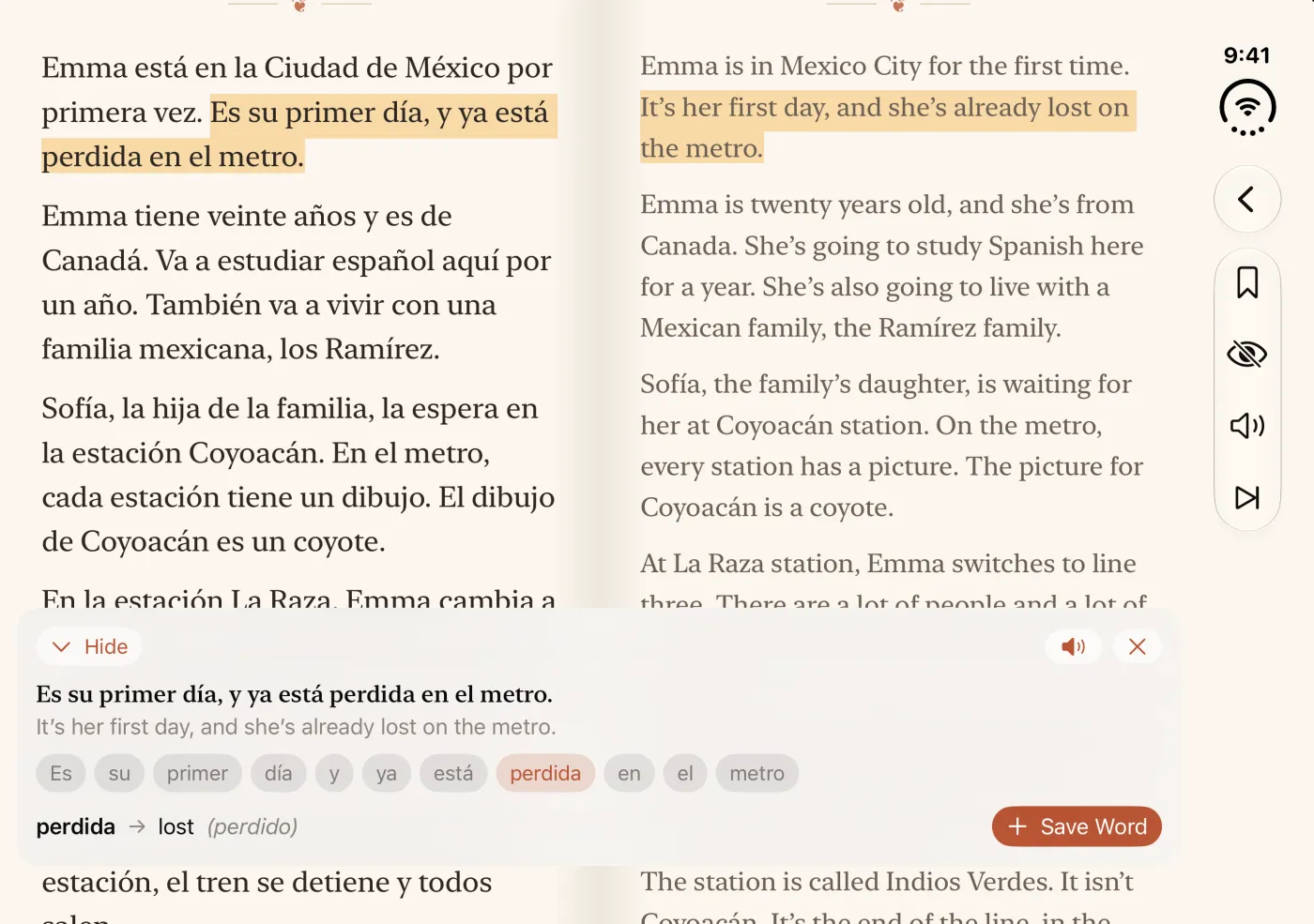
How that looks depends on what you’re holding. On an iPhone Duo opened flat it is simply a book: the story on the left page, your language on the right, divided at the fold. Held upright, the two pages stack. An iPad shows the same spread, and on an Android foldable the pages split along the fold. On an ordinary iPhone, or a Duo folded shut, you get one page in the language you’re learning, and a sentence’s translation slides up only when you tap it. Why the sentence is the right thing to match is argued in our guide to parallel text; how the book works on the fold, in reading on iPhone Duo.
Meaning in context
The word is the second job, and it’s where a reading app parts company with a translator. A dictionary gives you a word’s meanings. A reading app should give you its meaning, the one in this sentence.
In Facing Pages you tap a sentence, its words appear as buttons in a panel below, and a tap on any of them shows what it means there, with the dictionary form in parentheses. Perdida, on Emma’s first day on the Mexico City metro, is “lost (perdido).” Soltó, in soltó una carcajada, is “let out (soltar),” while the same verb in another story, where a young sloth nunca suelta su cobija, is “lets go of.” For the Spanish and French stories, those meanings come from a glossary made for each story, word by word, with a separate entry wherever one sentence uses a word differently from the rest.
It matters most for the commonest words, because they’re the ones with the most meanings. The same 21 free stories gloss llevar as “carried,” “wore,” “took” and “had been,” the last in Inés llevaba meses estudiando, which an English speaker would put as “had been studying for months.” Look llevar up in a dictionary and you meet a dozen senses or more, and take the first. Tap it and you meet one, the right one, and across a few dozen stories you collect the rest in the order you need them.
One limit, stated plainly: the English stories have no such glossary. Tap a word in one and your phone translates that word on its own, without its sentence. If a meaning looks wrong, especially for a short verb with up or off after it, read the whole sentence on the facing page.
The button that hides the English
Anyone who has read with a translation beside them knows the drift. You check a hard sentence, then the next one, and a page later you’re reading the story in your own language and nodding at the original as it goes by. The translation that rescues you is the same one that makes it so easy to stop trying.
So the most useful control in a bilingual reading app is the one that takes the second language away. In Facing Pages, Hide Translation empties the facing page on an iPhone Duo or an iPad; tap a sentence and its translation still appears in the panel below, one sentence at a time. On a regular iPhone the app works that way already.
Then make every look a decision. Read the sentence through, read it again, and only then tap. After you’ve seen the translation, go back and read the original once more: the third reading, with the meaning already in hand, is the one where you see how the sentence was built.
Listening
Reading gives you time. It doesn’t give you sound. French leaves letter after letter unpronounced at the ends of its words, as our guide to learning French by reading shows, and even Spanish, which spells almost as it speaks, keeps its rhythm and the way its words run together off the page.
In Facing Pages, Listen reads the story aloud from where you are to the end, highlighting each sentence as it’s spoken, and the speaker button in the panel reads only the sentence you tapped. The voices are your own device’s, and the app asks for one that fits the setting: a voice from Spain for a story set in Seville, a Mexican voice for one set in Puebla or Bogotá, a British voice for an English story in London. (The differences you’ll hear are laid out in Mexican Spanish vs Spain Spanish.) A slider in Settings runs from slow to natural speed.
Keeping words
Here is the uncomfortable research. In 2008, Ronan Brown, Rob Waring and Sangrawee Donkaewbua had learners of English meet sets of 28 new words in stories, by reading, by reading while listening, or by listening alone. New words were picked up in all three ways, but most were not, and on a test of unprompted recall three months later the learners kept, on average, the meaning of one of the 28 words they had met in either reading mode. Words that came up more often in the text were more likely to last.
Repetition is the lever. When Ana Pellicer-Sánchez and Norbert Schmitt had advanced learners read the whole of Chinua Achebe’s Things Fall Apart, in a study published in 2010, the words they met more than ten times were largely learned, though not completely: learners recognized the meaning of 84 percent of them and could recall the meaning of 55 percent.
So reading finds words, and something else has to keep them. A reading app can help twice. The first is a word list that remembers where each word came from. Save Word in Facing Pages keeps the word, its meaning, its dictionary form, the whole sentence and the story’s title in My Words. It’s a list, not a drill, so the reviewing is yours to do; when you go through it, read the sentence, not just the pair.
The second is stories that bring the same words back. Our library has 36 series told in episodes, with the same people and streets from one episode to the next, so a word from the first turns up again in the fourth, in a sentence you haven’t seen. That is the repetition the research asks for, arriving without a flashcard in sight.
Save the word you expect to meet again, not the one that merely surprised you.
Levels
Facing Pages has three, set against the Council of Europe’s CEFR scale: beginner (A1–A2), intermediate (B1) and advanced (B2–C1). A beginner story runs 150 to 300 words and stays within about the 1,000 most common words; an intermediate one, 400 to 700 words within about 2,500; an advanced one, 900 to 1,500 words with no such limit. You pick a level when you start and change it in Settings, and each cover shows how many minutes the story takes. Our guide to the CEFR levels explains what each one means for a reader.
The right level for a bilingual app isn’t the one you could manage alone. It’s a step above, where you need the facing page two or three times a page. If you’re tapping across every other line, drop a level. If a whole story goes by without a tap, hide the translation for good, or move up.
Facing Pages · bilingual stories
Read Spanish and French with English matched sentence by sentence
228 original stories in Spanish, French and English, with your own language on the facing page, matched sentence by sentence. The first episode of every series is free, and there’s no account to make.
Reading this on a computer?
Scan the code with your phone’s camera. It opens the App Store or Google Play, whichever your phone uses. No account needed.
Or text yourself the linkA routine for twenty minutes a day
Twenty minutes every day will take you further than two hours on a Sunday, because words fade between meetings. Here is how we’d spend them, on five paragraphs from near the end of El restaurante de mi padre. A daughter has been running her father’s small restaurant in Puebla while he’s at the beach, and a week of notes from the customers has told her what to change: not the mole, but the sad bolero he played every afternoon at two. Now her parents are back.
Un mes después, mis papás volvieron de Veracruz, muy bronceados y muy contentos. Mi papá entró a la fonda, saludó a todos y se sentó con don Chema. A las dos en punto, por primera vez en treinta y cinco años, no sonó su bolero. Todos los clientes dejaron de comer y lo miraron, un poco nerviosos.
A month later, my parents came back from Veracruz, very tanned and very happy. My dad walked into the restaurant, said hello to everyone and sat down with Don Chema. At two o’clock sharp, for the first time in thirty-five years, his bolero didn’t play. All the customers stopped eating and looked at him, a little nervous.
«¿Y mi canción?», preguntó mi papá.
“What about my song?” asked my dad.
«La quité, papá», le contesté en voz baja.
“I took it off, Dad,” I answered quietly.
Mi papá miró a los clientes, uno por uno. Luego soltó una carcajada enorme.
My dad looked at the customers, one by one. Then he let out an enormous laugh.
«¡Por fin! Yo no la soportaba, pero la ponía porque pensaba que a ustedes les encantaba», dijo.
“Finally! I couldn’t stand it, but I played it because I thought you all loved it,” he said.
- Read it with the translation hidden. At B1 most of it should come. The likely snags are bronceados, tanned, and dejaron de comer, where dejar de plus an infinitive means to stop doing something.
- Tap sentences before words. If no sonó su bolero won’t come clear, the sentence tells you more than sonó alone: here sonar isn’t “to sound” but “to play,” said of music. La quité, “I took it off,” uses quitar for a record just as English uses “take off.”
- Save one or two words, not six. Soportaba, “could stand,” from soportar, is worth keeping: no lo soporto, I can’t stand it, is everyday Spanish. Carcajada, a loud laugh, can wait until you meet it again.
- Listen to the same page, slowly first, then at natural speed, following the highlight.
- Tomorrow, reread it before anything new. The second time through is usually the first time it feels like reading.
On a beginner story the same twenty minutes covers the whole thing three times, with the audio. Free stories to practice the routine on are in our Spanish short stories for beginners.
What stays on your phone
Spanish and French stories carry our own English inside the story, along with the word glossary, so the facing page and every lookup work without a connection. The free stories come inside the app; a subscriber’s stories download once per language and stay on the phone.
For a facing page in one of about 20 other languages, from Japanese to Ukrainian, the phone does the translating: Apple’s translation framework on iPhone and iPad, Google’s ML Kit on Android. Each language downloads once and then works offline. Apple’s documentation says every translation made through its framework is processed on the device, and the story text is never sent to us. There’s no account to create and no advertising.
Machine translation has limits, and Google’s documentation calls on-device translation “intended for casual and simple translations.” That’s why our Spanish and French stories come with English written for them, and why a machine-made facing page is best used the way we’d use any translation: as a check, not as the text you read.
Every other book you own keeps its translation in a different volume, or has none. A bilingual reading app is the one book that can hand you its translation a sentence at a time and take it back again. Tonight, start a story with the facing page hidden and count your taps. Count them again next week.
Questions
What is a bilingual book?
A book printed in two languages, usually the original on one page and a translation on the facing page, so a reader can check one against the other. Many are for young children. For adult learners, the ones worth having are matched closely, ideally sentence by sentence.
What is the best free bilingual reading app?
We make Facing Pages, so weigh our answer accordingly. Whatever you try, check for a translation matched sentence by sentence, word meanings that fit the sentence, audio of the same text and a way to hide the translation. In Facing Pages, the first episode of every series and a selection of stories at every level are free, 21 in each of Spanish, French and English, with no account and no ads. Facing Pages Premium, at $5.99 a month, opens the rest.
Is there an app that translates books?
Facing Pages translates only its own stories: Spanish and French come with our English, and your phone translates the facing page into about 20 other languages. It doesn’t open books you already own. If you translate one of those some other way, check a sentence at a time, after you’ve tried it, rather than a chapter in advance.
Can you learn a language by reading books?
You can build a large vocabulary and a real feel for the grammar mostly by reading, as long as what you read is easy enough that you know almost every word. Speaking and fast speech need practice of their own, so listen to what you read. Our guide to learning Spanish by reading sets out how easy is easy enough.
Does reading out loud help you learn a language?
It makes you notice what silent reading lets you skip: every syllable, the stress, the places where words join. Listen to a sentence first, so you copy a good model rather than practice a mistake, then say it yourself. In Facing Pages, tap a sentence and use the speaker button to hear it as often as you like.
How many minutes a day should you spend learning a language?
There’s no agreed number, but a short session every day beats a long one every week. Twenty minutes a day is enough to read a beginner story three times and listen to it once, or to read an intermediate story twice.
Facing Pages · bilingual stories
Read Spanish and French with English matched sentence by sentence
228 original stories in Spanish, French and English, with your own language on the facing page, matched sentence by sentence. The first episode of every series is free, and there’s no account to make.
Reading this on a computer?
Scan the code with your phone’s camera. It opens the App Store or Google Play, whichever your phone uses. No account needed.
Or text yourself the link