Guides · Stories
Spanish short stories for intermediate learners.
Two complete B1 stories, from Cartagena and Buenos Aires, and the opening of a third from Madrid, with our English beside every paragraph and the past tenses that drive them.
October 23, 2026
In La entrevista, a B1 story set in Buenos Aires, you get the same ten years of children’s television twice. The narrator says Graciela presentó her show for a decade. Facundo, who watched it every afternoon as a boy, tells her eso es lo que usted decía en la tele: that’s what you used to say on TV. Each line uses a different past tense, and both are correct Spanish.
Beginner stories can stay in the present tense, but at B1 you read stories told in the past, where Spanish needs two tenses at once, the preterite and the imperfect. The rule most learners start with, imperfect for what lasted or repeated and preterite for what happened once, can’t explain Graciela’s decade, and the two complete stories below, from Colombia and Argentina, can. The opening of a third, from Madrid, adds a past tense that Spaniards use and Colombians and Argentinians mostly don’t.
The short answer
This page has two complete B1 Spanish short stories with English translation: El misterio del Hotel Paraíso, a mystery in Cartagena, Colombia, and La entrevista, a job interview in Buenos Aires, plus the opening of Radio Sierra, set in Madrid. Our English sits beside every paragraph.
At B1 you read stories narrated in the past, so you meet the preterite and the imperfect in nearly every paragraph. To choose between them, ask whether the sentence shows an action from outside, finished, with both ends in view, or from inside, while it was still going on. The action’s length doesn’t decide the tense.

Facing Pages · bilingual stories
More B1 Spanish stories, with English on the facing page
228 original stories in Spanish, French and English, with your own language on the facing page, matched sentence by sentence. The first episode of every series is free, and there’s no account to make.



Reading this on a computer?
Scan the code with your phone’s camera. It opens the App Store or Google Play, whichever your phone uses. No account needed.
Or text yourself the linkThe step up to B1
We write our own stories to these limits:
| Our limits | Beginner (A1–A2) | Intermediate (B1) |
|---|---|---|
| Length | 150 to 300 words | 400 to 700 words |
| Sentences | 10 words on average, 14 at most | 15 words on average, 22 at most |
| Vocabulary | About the 1,000 most common words, plus up to 8 topic words | About the 2,500 most common words, plus up to 12 topic words |
| The past | None at A1; at A2, the preterite of regular verbs and five common irregular ones | Preterite and imperfect side by side, and the present perfect (he visto) |
| Other grammar | The present, ir a + infinitive for the future, gustar | Adds the future, the conditional, commands, and the subjunctive after quiero que, ojalá and para que |
On paper the step looks smaller than it is. According to Hu and Nation’s research, you need about 98 percent of a text’s words to follow it unaided (see how to learn Spanish by reading); in a 600-word story that still leaves a dozen unknown words, many of them the story’s own topic words, an arepa de huevo here, a colectivo there. At B1 the verbs stop you far more often than the words do.
At A1 you read a verb for who and when. At B1 you also read it for where the narrator is standing: outside a moment, seeing it whole, or inside it while it was still going on. The Real Academia Española draws the same line in its grammar glossary, and length isn’t part of it: the preterite presents a situation as finished, and the imperfect places it in the past without alluding to its end.
A missing key in Cartagena: El misterio del Hotel Paraíso
Start with the first episode of a mystery series. Valentina, twenty, works the front desk of a small hotel inside Cartagena’s old city walls. She reads mystery novels in her spare time and complains that nothing ever happens at work, until Monday morning, when something does.
El lunes por la mañana, Valentina Marrugo llegó a la recepción del Hotel Paraíso y notó algo raro. En el tablero de las llaves, el gancho número siete estaba vacío.
On Monday morning, Valentina Marrugo arrived at the front desk of the Hotel Paraíso and noticed something strange. On the key rack, hook number seven was empty.
El Hotel Paraíso era una casa colonial en el barrio San Diego, dentro de la ciudad amurallada de Cartagena. Tenía paredes amarillas, balcones de madera y flores fucsias que caían sobre la calle. En el patio había una fuente, muchas plantas y una tortuga muy vieja llamada Capitán. Detrás de la muralla, a solo una cuadra, brillaba el mar Caribe. Era temprano, pero ya hacía calor, y la brisa del mar movía las cortinas.
The Hotel Paraíso was a colonial house in the San Diego neighborhood, inside the walled city of Cartagena. It had yellow walls, wooden balconies and fuchsia flowers that spilled down over the street. In the courtyard there was a fountain, lots of plants and a very old tortoise named Capitán. Beyond the city wall, just one block away, the Caribbean Sea sparkled. It was early, but it was already hot, and the sea breeze was stirring the curtains.
Valentina tenía veinte años y trabajaba en la recepción desde enero. Por las noches estudiaba turismo, y en su tiempo libre leía novelas de misterio. Siempre se quejaba de que en el hotel nunca pasaba nada interesante.
Valentina was twenty years old and had worked at the front desk since January. At night she studied tourism, and in her free time she read mystery novels. She always complained that nothing interesting ever happened at the hotel.
Detrás del mostrador colgaban doce llaves antiguas de bronce, cada una con un número de madera. Solo la llave de la siete era distinta, porque era una copia moderna y brillante. Según doña Mercedes, la dueña del hotel, la llave original se perdió hace muchísimos años.
Behind the counter hung twelve antique bronze keys, each with a wooden number tag. Only the key to room seven was different, because it was a shiny modern copy. According to Doña Mercedes, the owner of the hotel, the original key had been lost many, many years ago.
Además, la habitación siete llevaba años cerrada. Era la más bonita del hotel, con un balcón desde donde se veía el mar. Doña Mercedes siempre decía que el piso necesitaba arreglos, pero nunca llamaba a ningún obrero.
What’s more, room seven had been closed for years. It was the prettiest room in the hotel, with a balcony that looked out over the sea. Doña Mercedes always said the floor needed repairs, but she never called in any workmen.
Valentina buscó la llave debajo del mostrador, en los cajones y hasta entre las plantas del patio. No la encontró por ninguna parte. Entonces fue a la cocina, donde Yesenia preparaba arepas de huevo para el desayuno.
Valentina looked for the key under the counter, in the drawers and even among the plants in the courtyard. She couldn’t find it anywhere. Then she went to the kitchen, where Yesenia was making arepas de huevo for breakfast.
«Yesenia, ¿tú viste la llave de la siete?», preguntó Valentina.
“Yesenia, have you seen the key to room seven?” asked Valentina.
«Nadie entra a la siete, mija, ni siquiera las camareras», respondió Yesenia sin dejar de cocinar. La cocina olía a maíz, a huevo frito y a café recién hecho.
“Nobody goes into room seven, honey, not even the housekeepers,” Yesenia answered without stopping her cooking. The kitchen smelled of corn, fried egg and freshly made coffee.
Después, Valentina fue a la oficina de doña Mercedes, al fondo del patio. La dueña estaba sentada junto a la ventana y miraba una foto vieja en blanco y negro. Valentina alcanzó a ver a dos niños sonrientes en el patio del hotel, al lado de una tortuga. Doña Mercedes guardó la foto rápidamente en un cajón.
Next, Valentina went to Doña Mercedes’s office, at the back of the courtyard. The owner was sitting by the window, looking at an old black-and-white photo. Valentina caught a glimpse of two smiling children in the hotel courtyard, next to a tortoise. Doña Mercedes quickly put the photo away in a drawer.
«Doña Mercedes, la llave de la habitación siete desapareció», dijo Valentina.
“Doña Mercedes, the key to room seven has disappeared,” said Valentina.
«Tranquila, mija, ya aparecerá», contestó la señora sin mirarla a los ojos. Luego cambió de tema y le preguntó por las reservas de la semana.
“Don’t worry, dear, it’ll turn up,” the woman replied, without looking her in the eye. Then she changed the subject and asked her about the week’s reservations.
Valentina salió de la oficina muy pensativa. Doña Mercedes se preocupaba por todo, hasta por una cucharita perdida. ¿Por qué ahora no le importaba una llave?
Valentina left the office deep in thought. Doña Mercedes worried about everything, even a lost teaspoon. So why didn’t she care about a key now?
De vuelta en la recepción, Valentina abrió el libro de huéspedes. Solo había un huésped nuevo en el hotel: el señor Joaquín Lara, de Bogotá. Llegó el sábado por la noche y pidió una habitación específica: la ocho, justo al lado de la siete.
Back at the front desk, Valentina opened the guest book. There was only one new guest at the hotel: Mr. Joaquín Lara, from Bogotá. He had arrived on Saturday night and asked for a specific room: number eight, right next to room seven.
Desde ese día, el señor Lara no salía de su cuarto para nada. Pedía todas las comidas en la habitación y no hablaba con nadie. Un huésped misterioso y una llave perdida en la misma semana no podían ser una casualidad.
Since then, Mr. Lara hadn’t left his room for anything. He ordered all his meals to his room and didn’t talk to anyone. A mysterious guest and a missing key in the same week couldn’t be a coincidence.
Esa mañana, Valentina decidió llevarle ella misma el desayuno al señor Lara. Subió con la bandeja por la vieja escalera de madera, que crujía con cada paso. Desde el corredor del segundo piso se veía todo el patio, con su fuente y sus plantas. Tocó dos veces la puerta número ocho.
That morning, Valentina decided to take Mr. Lara his breakfast herself. She carried the tray up the old wooden staircase, which creaked with every step. From the second-floor corridor you could see the whole courtyard, with its fountain and its plants. She knocked twice on door number eight.
«Siga, Valentina, la puerta está abierta», dijo una voz tranquila desde adentro.
“Come in, Valentina, the door is open,” said a calm voice from inside.
Valentina se quedó inmóvil en el corredor. Ese señor no la conocía, y ella nunca le dijo su nombre.
Valentina froze in the corridor. That man didn’t know her, and she had never told him her name.
Read the first paragraph again, for the verbs only. Llegó and notó are preterites, two events in a row that push the story forward. Estaba vacío is imperfect: the state of the hook at the moment she looked. In the second paragraph the clock stops. Era, tenía, caían, había, brillaba, era, hacía, movía: eight imperfects and not a single preterite, because nothing happens while the narrator looks around the courtyard.
You meet the use learners trip on most in the kitchen. In fue a la cocina, donde Yesenia preparaba arepas de huevo, Valentina’s walk is an event; Yesenia’s cooking was already under way when she came in, so it’s imperfect, and our English says “was making”. Yesenia answers sin dejar de cocinar.
Now look across at the English and count the times it says “had”. None of our free B1 stories uses the Spanish pluperfect (había dicho); wherever our English needs “had”, the Spanish keeps to the preterite and the imperfect:
| The Spanish | Our English |
|---|---|
| trabajaba en la recepción desde enero | had worked at the front desk since January |
| la llave original se perdió hace muchísimos años | the original key had been lost many, many years ago |
| la habitación siete llevaba años cerrada | room seven had been closed for years |
| Llegó el sábado por la noche | He had arrived on Saturday night |
| ella nunca le dijo su nombre | she had never told him her name |
Borrow two of those for your own Spanish. The imperfect with desde describes something that began earlier and was still true at the moment of the story. Llevar plus a stretch of time is everyday Spanish for “had been … for years”, and it works in the present too: llevo dos años aquí, I’ve been here two years.
One line sounds Colombian in a way you might miss if you learned the Spanish of Spain. Valentina asks the cook ¿tú viste la llave de la siete? about something that can only have happened that morning. In much of Spain the natural question would be ¿has visto la llave?, with the present perfect; in most of Latin America the preterite does that job, as the RAE notes in the same glossary.
San Diego, the hotel’s neighborhood, is a real place: one of the three quarters of the old walled city, the one where, UNESCO notes, merchants and the middle class lived; the walled city has been a World Heritage site since 1984.
A job interview in Buenos Aires: La entrevista
The second story is a comedy, complete in one episode. Graciela is fifty-four, spent years in television and now wants to write stories for children. Her interview is at a small children’s publisher in Palermo, and the young director is far more nervous than she is.
El entrevistador entró a la sala, le dio la mano a Graciela y volcó un vaso de agua sobre su currículum. Después se sentó, se levantó otra vez y se le cayeron todos los papeles al suelo.
The interviewer came into the room, shook Graciela’s hand and knocked a glass of water over her résumé. Then he sat down, stood up again and dropped all his papers on the floor.
«Perdón, perdón, es que hoy hace mucho calor», dijo el joven, rojo como un tomate. Era julio, pleno invierno en Buenos Aires, y afuera hacía seis grados.
“Sorry, sorry, it’s just that it’s very hot today,” said the young man, as red as a tomato. It was July, the middle of winter in Buenos Aires, and it was six degrees Celsius outside.
Graciela tenía cincuenta y cuatro años y dos hijos ya grandes. Durante muchos años trabajó en la televisión, pero ahora quería otra cosa: escribir cuentos para chicos. Por eso estaba allí, en una pequeña editorial de libros infantiles en Palermo. En el colectivo estaba un poco nerviosa, pero ahora, frente a ese joven, se sentía muy tranquila.
Graciela was fifty-four years old and had two grown-up children. For many years she had worked in television, but now she wanted something different: to write stories for kids. That was why she was there, at a small children’s book publisher in Palermo. On the bus she had felt a little nervous, but now, facing that young man, she felt very calm.
El joven se llamaba Facundo y era el director de la editorial. Tenía unos treinta años, una corbata nueva y, sobre el escritorio, un mate frío sin tomar. Cada vez que Graciela hablaba, él la miraba con los ojos muy abiertos. Sus preguntas también eran un poco raras.
The young man’s name was Facundo, and he was the director of the publishing house. He was about thirty, with a new tie and an untouched cup of cold mate on his desk. Every time Graciela spoke, he stared at her with wide eyes. His questions were a little strange, too.
«¿Cuál es su color favorito?», le preguntó Facundo.
“What’s your favorite color?” Facundo asked her.
«El amarillo», respondió Graciela, sorprendida.
“Yellow,” Graciela answered, surprised.
«¿Y todavía sabe silbar con dos dedos?», preguntó él.
“And can you still whistle with two fingers?” he asked.
Graciela no entendía nada. Pensó que quizás tenía una miga de medialuna en la cara, y se tocó la mejilla con disimulo. Mientras tanto, Facundo intentaba leer el currículum mojado, y se le cayó la lapicera dos veces. Entonces Graciela sonrió y habló con su voz más tranquila.
Graciela didn’t understand a thing. She wondered if she had a crumb of medialuna on her face, and she discreetly touched her cheek. Meanwhile, Facundo was trying to read the wet résumé, and he dropped his pen twice. Then Graciela smiled and spoke in her calmest voice.
«Respire hondo, cierre los ojos y cuente hasta diez conmigo», le dijo.
“Take a deep breath, close your eyes and count to ten with me,” she told him.
Facundo obedeció, y contaron juntos en voz baja. Cuando abrió los ojos, estaba sonriendo como un nene.
Facundo did as he was told, and they counted together quietly. When he opened his eyes, he was smiling like a little boy.
«Eso es lo que usted decía en la tele, todas las tardes a las cinco», dijo él.
“That’s what you used to say on TV, every afternoon at five,” he said.
Graciela se quedó con la boca abierta. Durante diez años presentó «La merienda de Graciela», un programa para chicos. En el programa cantaba, contaba cuentos y, al final, silbaba con dos dedos. Pero de eso hacía ya más de veinte años.
Graciela’s mouth fell open. For ten years she had hosted “La merienda de Graciela,” a show for kids. On the show she sang, told stories and, at the end, whistled with two fingers. But all that had been more than twenty years ago.
«Yo miraba su programa todos los días con mi abuela. Aprendí a leer con sus cuentos. Por eso estoy tan nervioso», confesó Facundo.
“I watched your show every day with my grandmother. I learned to read with your stories. That’s why I’m so nervous,” Facundo confessed.
Graciela se rio, pero después se puso seria. «Gracias, Facundo, me alegra mucho. Pero no quiero un trabajo por un programa viejo. Quiero que lea mis cuentos nuevos», le dijo.
Graciela laughed, but then she turned serious. “Thank you, Facundo, that makes me very happy. But I don’t want a job because of an old TV show. I want you to read my new stories,” she told him.
Facundo leyó los tres cuentos de su carpeta. Tardó veinte minutos y no dijo ni una palabra. Por primera vez en toda la mañana, Graciela empezó a ponerse nerviosa. Por fin, Facundo levantó la vista.
Facundo read the three stories in her folder. It took him twenty minutes, and he didn’t say a single word. For the first time all morning, Graciela started to feel nervous. At last, Facundo looked up.
«Son muy buenos. Si quiere, el lunes empieza a trabajar con nosotros», dijo con una sonrisa.
“They’re very good. If you’d like, you can start working with us on Monday,” he said with a smile.
Cuando Graciela abrió la puerta para salir, se llevó otra sorpresa. En el pasillo estaban los seis empleados de la editorial, todos de unos treinta años. Escucharon toda la entrevista detrás de la puerta.
When Graciela opened the door to leave, she got another surprise. In the hallway stood all six of the publisher’s employees, every one of them about thirty. They had listened to the whole interview from behind the door.
«¿Puede silbar como en la tele, por favor?», le pidió una diseñadora.
“Could you whistle like you did on TV, please?” asked one of the designers.
Graciela se puso dos dedos en la boca y silbó con todas sus fuerzas. Todos aplaudieron, y en la sala, del susto, Facundo volcó otro vaso de agua.
Graciela put two fingers in her mouth and whistled as hard as she could. Everyone clapped, and back in the room, startled, Facundo knocked over another glass of water.
Go back to Graciela’s ten years. In durante diez años presentó «La merienda de Graciela», the narrator stands outside the decade and measures it from end to end, and a period with both ends in view takes the preterite however long it lasted. The RAE illustrates the tense with Durante toda su vida se manifestó en contra de las injusticias, where one preterite covers a whole lifetime. Facundo is inside the same years. Yo miraba su programa todos los días con mi abuela, he says, and eso es lo que usted decía en la tele, todas las tardes a las cinco. Those afternoons had no edges for a boy in front of the television, and Facundo still describes them from inside.
With feelings the split is the same. En el colectivo estaba un poco nerviosa and se sentía muy tranquila are states, so they’re imperfect. Then, while Facundo reads her stories in silence, Graciela empezó a ponerse nerviosa: the moment a feeling starts is an event, and it takes the preterite. So do se puso seria and se quedó con la boca abierta, each a change you could point to on a clock.
The story never uses vos, the informal “you” that the RAE’s Diccionario panhispánico de dudas describes as the form for familiar address in Argentina, Paraguay and part of Uruguay. We keep vos for our advanced stories, but this one wouldn’t need it. Facundo is interviewing an older woman he grew up watching, so it’s usted, the form of respect, on both sides. Graciela takes charge in usted commands, respire hondo, cierre los ojos y cuente hasta diez conmigo, which borrow the forms of the present subjunctive. A few lines later she uses the subjunctive itself, after quiero que: quiero que lea mis cuentos nuevos.
You can hear the Río de la Plata in the vocabulary. Graciela rides the colectivo, which the RAE lists in its dictionary as the word for a bus in Argentina, Bolivia, Ecuador, Paraguay and Peru. She worries about a crumb of medialuna, the Río de la Plata name for a croissant. You need the map for the opening joke, too: Facundo blames the heat in July, midwinter in Buenos Aires, with six degrees Celsius outside.
Facing Pages · bilingual stories
More B1 Spanish stories, with English on the facing page
228 original stories in Spanish, French and English, with your own language on the facing page, matched sentence by sentence. The first episode of every series is free, and there’s no account to make.
Reading this on a computer?
Scan the code with your phone’s camera. It opens the App Store or Google Play, whichever your phone uses. No account needed.
Or text yourself the linkSpain’s other past: Radio Sierra
Last comes an opening from the first episode of a series that begins in Madrid and moves to Alájar, a white village in the hills of Huelva. Read it for two verbs.
El lunes a las nueve, Lucía tenía trabajo en la emisora de radio más grande de Madrid. A las nueve y cuarto, ya no lo tenía.
At nine o’clock on Monday, Lucía had a job at the biggest radio station in Madrid. By a quarter past nine, she didn’t.
Su jefe la llamó a su despacho y le explicó todo en tres minutos. La emisora cerraba el programa de la mañana, y ya no necesitaban a Lucía. Después de cuatro años de trabajo, la despidieron.
Her boss called her into his office and explained everything in three minutes. The station was canceling the morning show, and they didn’t need Lucía anymore. After four years of work, they fired her.
Lucía tenía veintiséis años. En la emisora preparaba los programas de otras personas, buscaba canciones y contestaba el teléfono. Nunca hablaba por el micrófono.
Lucía was twenty-six. At the station she prepared other people’s shows, looked for songs and answered the phone. She never spoke into the microphone.
Esa tarde, sentada en un banco del parque del Retiro, llamó a su abuela Carmen.
That afternoon, sitting on a bench in Retiro Park, she called her grandmother Carmen.
«Abuela, me han despedido», dijo en voz baja.
“Grandma, I’ve been fired,” she said quietly.
«Pues vente a Alájar, mi niña. Aquí tienes una cama, pan recién hecho y todo el silencio del mundo», contestó su abuela.
“Then come to Alájar, sweetheart. Here you’ve got a bed, fresh bread and all the quiet in the world,” her grandmother answered.
The first comes in the first line: El lunes a las nueve, Lucía tenía trabajo, and by a quarter past she didn’t. She lost the job fifteen minutes later, and the verb is still imperfect, because the narrator stands at nine o’clock and looks at a state. If you think of the imperfect as the tense for long things, this is the counterexample; Graciela’s decade is the one from the other side.
The second is the firing, and you read about it twice. The narrator says la despidieron, a preterite, as a narrator would anywhere. Lucía calls her grandmother that same afternoon and says me han despedido, in the present perfect, the way Spaniards say it. As the RAE puts it in its glossary, in much of European Spanish the present perfect can describe recent, even immediate events, where most of Latin America requires the preterite. Valentina in Cartagena asked ¿tú viste?, and a receptionist in Madrid would more likely ask ¿has visto?
Speakers in Spain have one more form that the other two stories never need: vosotros, the friendly plural “you”. In Un día en Madrid, another free B1 story, a Madrid grandmother tells a Chilean tourist and her own granddaughter venid conmigo, que os invito a unas rosquillas. According to the RAE, Latin Americans don’t use vosotros; there ustedes covers every plural “you”, so the tourist would have said vengan.
Learn to read all of these forms, and speak the Spanish of the people you talk to: each form belongs to a region, and none is a mistake.
Using the English at B1
At A1 the English beside a story is a rescue line for a sentence that won’t come clear. At B1, look across for the verbs. English has one simple past tense, so a translator adds words to carry what Spanish packs into its endings, and those words point to the Spanish tense:
- “Was making”, “was sitting”: an action already under way. In the Spanish, the imperfect (preparaba, estaba sentada).
- “Used to”: a habit, and the imperfect again. In Las cometas de Sumpango, a grandmother remembers that her father hacía barriletes, “used to make kites”.
- “Would”: two jobs to tell apart. For a habit, the Spanish is imperfect; for the future seen from the past, the conditional. In Un día en Madrid, Ernesto’s plan is that primero iría al Palacio Real, “first he would go to the Royal Palace”.
- “Had”: something earlier than the story’s now. In these stories, a plain preterite or imperfect.
Read a B1 story twice: once straight through for the plot, looking across only when the story stops making sense, and once for nothing but the verbs, checking what our English had to do with any that surprise you. The second pass takes five minutes, and you’ll learn more from it about the two past tenses than from a page of rules.
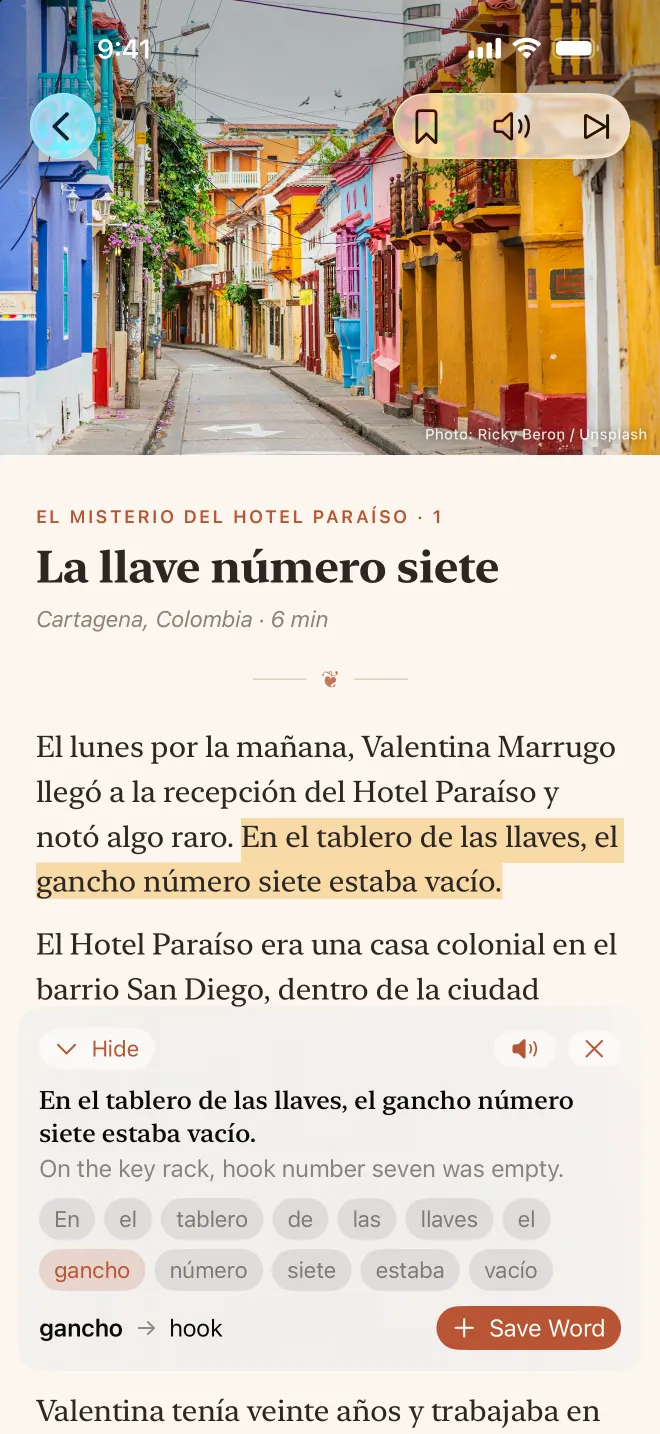
Once you can read a story with ease, hide the English. On an iPhone, or an iPhone Duo folded shut, Facing Pages shows the Spanish page alone and slides up the English only for the sentence you tap. Our guide to parallel text has more on reading two languages side by side.
Your next stories
Stay at B1 longer than feels necessary. Four more free B1 stories in Facing Pages use the same two tenses in other places: Un día en Madrid; El restaurante de mi padre, in Puebla, Mexico; Las cometas de Sumpango, in Guatemala; and La minga, in Chiloé, Chile, where a whole island gets ready to move a house across the sea. The rest of Radio Sierra’s first episode is free too.
After those comes B2: stories of 900 to 1,500 words and the rest of the subjunctive, including the imperfect subjunctive in si clauses (si tuviera tiempo, iría). Four of our B2 stories are free, among them El último tango, set in Buenos Aires again.
You’re ready for them once you can read presentó and decía about the same ten years without stopping to work out why the tenses differ.
Questions
Is B1 Spanish intermediate?
Yes. In the Common European Framework of Reference, B1, which the framework calls Threshold, is the first of two “independent user” levels, above the basic levels A1 and A2 and below B2.
Is B1 Spanish fluent?
Not in the everyday sense. The CEFR describes a B1 user as able to understand the main points of clear, standard language on familiar matters and to handle most situations while traveling. You’ll still find novels written for native speakers slow going until B2 or later.
Do you use the preterite or the imperfect with durante?
Usually the preterite, because durante with a length of time puts edges around a period. That holds for a habit seen whole, too: durante años, todos escucharon ese bolero triste cada tarde, from El restaurante de mi padre. Describe the habit from inside, without measuring it, and it’s imperfect: todas las tardes a las dos, mi papá ponía en el tocadiscos el mismo bolero triste.
Do you use the preterite or the imperfect for age?
The imperfect, when age is background: Valentina tenía veinte años, Graciela tenía cincuenta y cuatro años. For the birthday itself, which is an event, use the preterite of cumplir: ayer cumplió veinte años.
Do Argentinians use vos?
Yes. The RAE describes vos as the form of informal address in Argentina, Paraguay and part of Uruguay, with its own verb forms (vos llegás for tú llegas). Usted remains the form of respect, and it’s the one the characters use throughout La entrevista, a job interview.
Where can I read Spanish short stories for intermediate learners for free?
This page has two complete B1 stories, with our English beside every paragraph. In the Facing Pages app, the first episode of every series and a selection of stories at every level are free, including seven B1 stories set in six countries.
Facing Pages · bilingual stories
More B1 Spanish stories, with English on the facing page
228 original stories in Spanish, French and English, with your own language on the facing page, matched sentence by sentence. The first episode of every series is free, and there’s no account to make.
Reading this on a computer?
Scan the code with your phone’s camera. It opens the App Store or Google Play, whichever your phone uses. No account needed.
Or text yourself the link